Moments Before Disaster: Travel Edition
Scene 1.
It's 3:30 in the morning, and I'm trying to rouse my family for an early flight to Sacramento. Our son is drowsy but compliant, and I've packed all his things already, so he is easy to get going. My husband likes to sleep in, shower, brush his teeth, and take extra time to check the security of the house before we go anywhere. I'm getting antsy because we have to drive an hour to the Portland Airport, and we never know just how long the security line will be, so I have a designated time for us to hit the road. We miss it by 15 minutes.
There is still hope when we reach the airport. The security line doesn't look bad and Portland is known for getting people through pretty quickly. Still, I check my watch anxiously as we scoot forward and put our bags into the bins for the scanner. I'm also sweating because I have packed a bottle of Miralax in my suitcase to take care of my son's digestive issues while we're away from home. Miralax is a white powder, a substance that I fear will catch TSA's attention.
I watch as my family's bags and jackets exit the scanning machine and roll onto the public-facing track where they can be retrieved. My suitcase takes the other track, behind the Plexiglass where luggage goes for extra scrutiny. I'm dismayed but not surprised. I stand by for a long five minutes, alternately staring at the suitcase and glancing at my watch, before someone opens it and inspects the Miralax bottle. They return it to me about 12 minutes before our plane is scheduled to depart.
We run.
Aftermath: We reach the gate mere seconds after an attendant turns her back and closes the heavy door to the jet bridge. It's too late; we're stuck at the airport for five hours, with a restless five-year-old, until the next available flight.
Scene 2.
I've just flown home to Portland from a vacation, and I'm buying a ticket for the MAX light rail to get from the airport to my apartment. It's sometime between 2009 and 2012, and I'm just hearing that Barack Obama is either arriving in or departing from Portland for a rally. His presidential aircraft needs to use a runway at our airport, so commercial air traffic is being grounded, light rail transportation is being paused, and I think there's a blockade on surrounding freeways as well. I don't have a smartphone, so a transit worker on the MAX platform has told me about this.
It's okay by me; I have no particular schedule and I've got a book to read. I take a seat on the unmoving train next to my two pieces of luggage and watch as the car fills with other recently-disembarked passengers. Everyone's face has a mixture of curiosity and anxiety, since we have no idea how long this transit pause will last. I feel fine at first, but after half an hour of waiting, my bladder starts to fill up. For all I know, we could be stuck for another 45 minutes, and I'm still about an hour away from home by transit. Biological panic begins to set in.
I'm at the end of the train closest to the airport terminal, and I know the bathroom is just around the corner from the entrance door. It should only take five minutes for me to dash in and dash out, especially if I lighten my load by leaving my bags on the train. I tell a fellow passenger that I'll be right back.
Aftermath: I return from the bathroom to find that the train has departed with my luggage on board. I fully panic and call the transit agency to see what my options are. While pacing around, my cell phone rings; it's a Good Samaritan who noticed my unattended bags and found my name and number written inside them. We arrange to meet at a platform a few stops away from the airport, so they can hand over my stuff. Everything is intact.
Scene 3.
I'm riding an awkwardly fitting rental bike at Central Park in New York. I am not used to the fully upright handlebars and the overall bulk of the bike compared to the touring bike I use at home. This rental bike has a thumb shifter on top of the handlebars that has likely been used by a thousand tourists before me, and it's hard to move. I'm fiddling with the shifter, pedaling with effort, and trying to figure out where the brakes are on this thing while navigating a gaggle of other people enjoying this 70-degree April day. East Drive is full of cyclists, walkers, joggers, roller skaters, and every few blocks a group of pedestrians trying to cut across the stream, which never fully stops even when we encounter a red light.
I finally shift into the correct gear and start to feel like part of the flow. It's beautiful out, and I have never seen the park so full of people. I feel like I'm experiencing it anew, covering all this ground on two wheels and pulling over to enjoy different vantage points. The day is getting hot, but I'm comfortable in a white tee and a breezy pair of linen short shorts that I just bought in SoHo.
It hasn't occurred to me that these shorts have no give in the fabric. Each time I get off the bike, I swing my leg around the back of the seat, and to get back on, I lift and swing that leg again. The shorts pull taut against my butt and thighs.
Aftermath: The shorts have ripped at the crotch and I'm about 40 blocks from where I started. I take an unplanned detour outside the park to a clothing store, where I wait in line for at least 20 minutes to buy a replacement pair of capris (more modest than short shorts). Then, I learn that it's very hard to find a bathroom to change in on the Upper West Side. I'm stuck in crotchless shorts until I get back to my hotel in Midtown.
Scene 4.
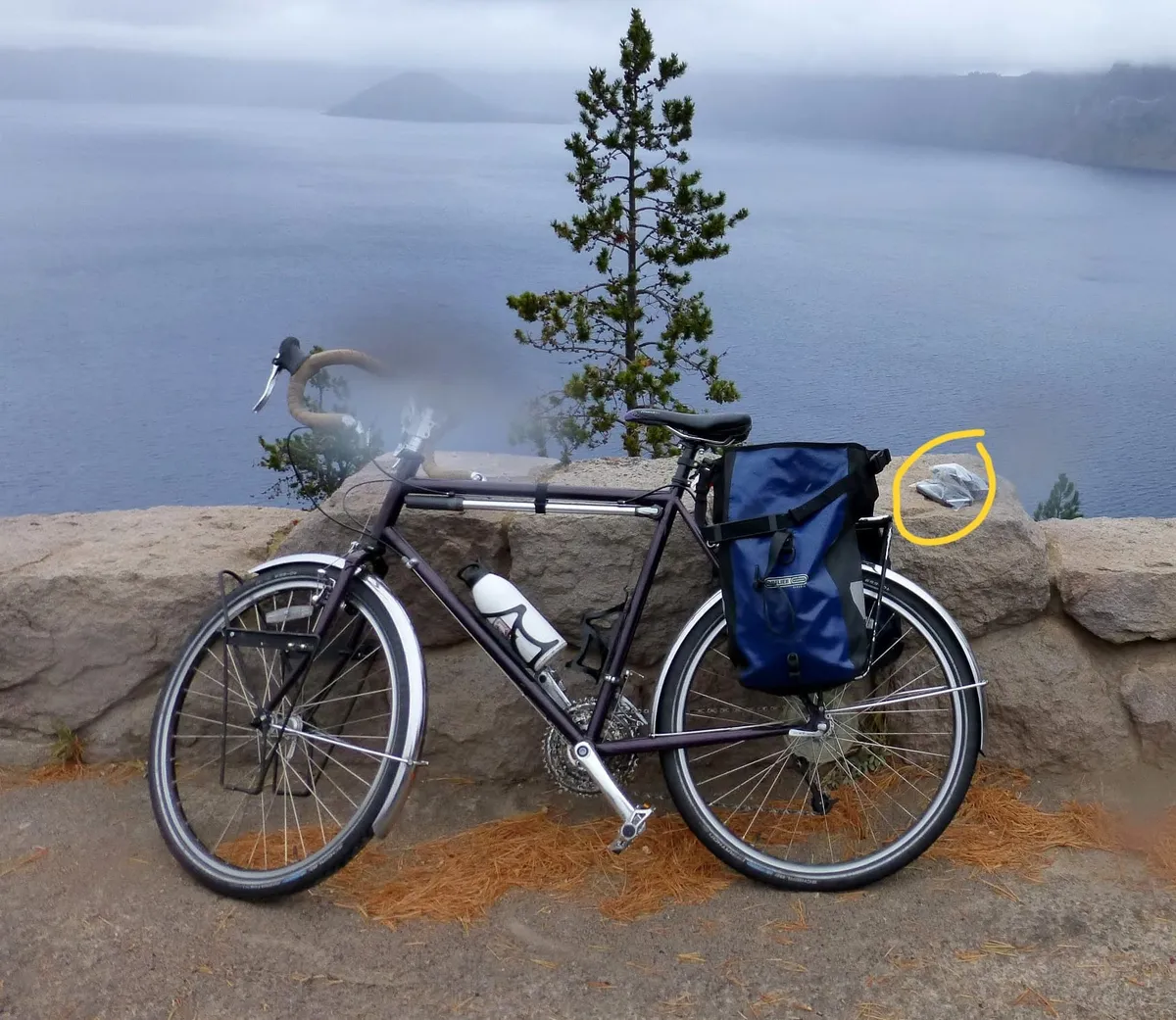
It's a car-free weekend at Crater Lake, Oregon, and my friend Fiona and I are biking along the lake's rim. Coming from the Willamette Valley, we really have to slog through the thin air at 7,000 feet, but we're loving the opportunity to enjoy gorgeous views with no car traffic to contend with. I haven't been to this park since I was a kid, and I'm in awe. We stop frequently to take pictures. It's 2013 and I have a Panasonic digital camera, which I keep in a plastic baggie along with my cell phone so they'll stay dry in the rainy, sleety weather.
I take a photo of the steely blue lake surface where it curves against the sandy brown and forest green of the rim. Then I put my camera back in the baggie, and set the baggie on the low stone wall that keeps people from climbing or tumbling down the interior slope of the crater. It's cold, and I'm distracted by thoughts of returning to the park lodge.
Aftermath: My friend Paul comes up to me in the lodge, where I'm sipping hot cocoa and unaware of what I left behind on the rim. He's gotten a Facebook message from my mom in California, who is worried because someone has turned in my phone to a park ranger, who called my emergency contact. She scoured my friends list and saw that Paul was posting photos of our cycling trip. Paul responds to my mom that I'm alive and well, and puts me in touch with the ranger so I can get my stuff back.
Scene 5.
My plane lands in Portland after I've been visiting family in California. We disembark at the far end of the terminal. It's nearly empty at this hour of night. I'm dragging my carry-on bag and I start to feel my stomach churn. Again. I spent the last half hour of this flight sitting alone, having barfed all over my lap and chased my neighbors away from their seats. The other passengers ignore me now, speeding toward the airport exit, but I remember them whispering: What's wrong with her? Is she pregnant? I'm not pregnant, but I'm definitely about to throw up and the nearest bathroom is too far away.
Aftermath: I run to the nearest trash can so I can vomit into it. I don't think my aim is great, and I'm sorry for whomever has to clean it up. Part of me feels like I should stay behind and offer to help with the cleaning, as if I've broken something in a shop, but I'm sick and exhausted. I scurry away.
Scene 6.1.
I'm stuck in LAX on a two-hour layover after a five-hour flight from Atlanta. I've had a scratchy throat since the night before, and I'm starting to understand that it's not just irritation from being outside in the winter cold, although the hunting trip I was on the day before must have been a contributing factor. My body is achy, my forehead is warm, and my stomach feels touchy. I'm wearing a KN95 face mask, and I'm hesitant to take it off and sit down and at one of the restaurants in Terminal 3, putting my germs within spitting distance of other patrons. But it's time for dinner and I won't be home for many more hours.
I decide on a fancy-ish restaurant that's owned by a Top Chef alum. Against my better judgment, I order a cocktail. (When I'm getting sick, sometimes I enjoy lying to myself that an alcoholic drink will help kill off the germs in my throat.) I also get a burger. At the next table is a group of doctors, maybe radiologists, talking about CT scans. One of the men is obviously more senior than the others, and he is mostly lecturing them—about how to inject contrast dye, how to ensure it spreads properly through the dendritic maze of a person's veins. I've never had a CT scan, and I eavesdrop with interest.
Scene 6.2.
I'm on my last flight from LAX to PDX. I managed to eat half of my burger at the airport, and now I'm trying to sleep on the plane since I'm feeling sicker by the minute. It is mainly body aches, but as we approach Portland, my stomach feels like it's about to take a turn as well. I stuff myself into the airplane bathroom and drop my head between my legs, bracing myself against the sway of the aircraft.
Scene 6.3.
Finally, after the longest travel day of my life, I'm in a shuttle van heading south from Portland to Salem. It's after 10:00 PM, yet everyone is chatty, especially the driver, who speaks loudly enough to maintain a conversation with the people in the back seat. I'm alone in the middle row, leaning against the window with mask on and eyes closed. I try my best to ignore their talk about television shows, and who stars in this one or that one, even when they're trying to remember an actor's name and I know who it is. (You can put me on your trivia team.) I'm sweating, so I take off my coat and continue sweating through my T-shirt.
At our destination, the driver grabs my suitcase from the back and says he hopes their stream of conversation didn't bug me. I tell him that it's fine, I'm just sick. "Oh," he says, "Is it COVID, or ...?"
Aftermath: I take a home COVID test and mistakenly read it as positive. The next day I review the instructions and realize my error, but I still don't know what's wrong with me. I feel like death. I end up going to the hospital and am diagnosed with pneumonia. The first round of antibiotics doesn't work, so I return to the hospital and this time they perform a CT scan, with contrast, to rule out a pulmonary embolism. I never get to see the images and admire my dendritic veins.
The second round of antibiotics takes effect. Disaster abates.